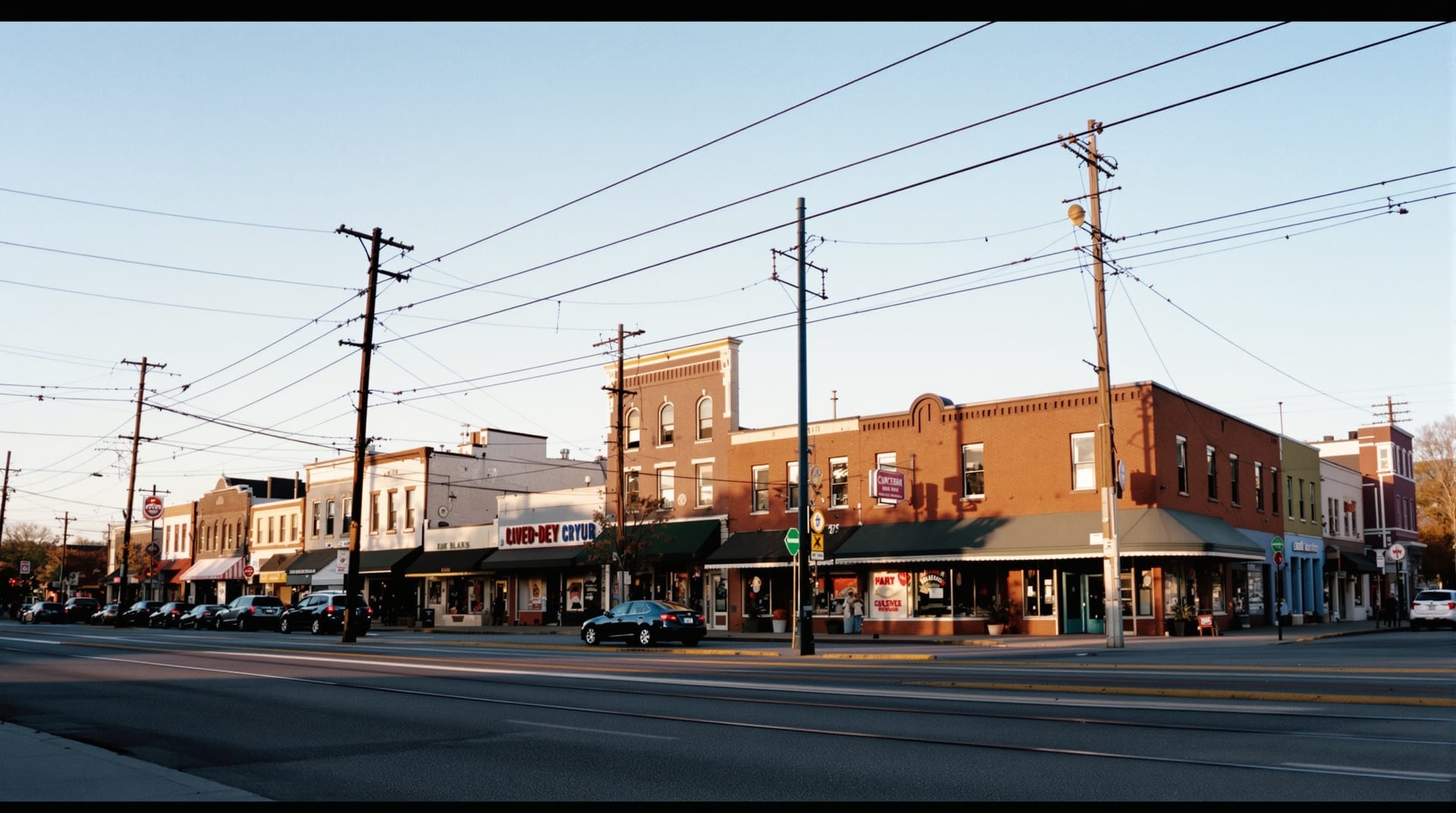
H Street NE runs east from behind Union Station for roughly a mile and a half, crosses the rail cut, climbs gently through a long wall of two- and three-storey commercial buildings, and ends where five roads collide at the intersection Washingtonians call the Starburst. It is one of the shortest main streets in the city and one of the most argued-about. For most of a century it was the shopping district for the neighbourhoods around it. For a long stretch after 1968 it was a byword for what disinvestment does to a street. And for more than fifty years, on one Saturday in early autumn, it has closed to traffic and filled up with stages, grills, folding tables and several hundred thousand people.
This guide is about that street. It is independent and unofficial — we do not organise the festival, we are not connected to any merchants’ group, main-street organisation or event producer, and nothing here is an announcement. What it is instead is a written record: where the corridor came from, why the festival exists, what the blocks actually contain, and what a visitor should know before walking it.
Why a street festival, and why here
Neighbourhood street festivals usually start for one of two reasons: someone wants to celebrate something, or someone wants to prove a street is still alive. The H Street tradition began firmly in the second category. It was organised by a coalition of residents and business owners in the years after the 1968 civil disturbances, at a point when a large share of the corridor’s storefronts were burned out, boarded, or simply gone. Closing the street for a day and filling it with people was an argument made in public: this is still a place.
That argument had to be made for a very long time. The corridor’s recovery was measured in decades, not years, and the festival outlasted several of the organisations that ran it. Stewardship passed from the original post-riot coalition to a merchants’ and professionals’ association in the 1980s, and then in the mid-2000s to a main-street programme working under the city’s economic-development office — the same commercial-district model, run through the National Main Street framework, that operates in dozens of American cities. You can read about that model at Main Street America.
What the corridor is made of
H Street NE is not one place. Planners have described it for years in three parts, and the division genuinely holds up on foot:
- The west end, closest to Union Station and the rail bridge — the most institutional stretch, closest to downtown and to the transit hub.
- The centre, the retail spine, where the corridor’s surviving pre-war commercial buildings sit shoulder to shoulder in an almost unbroken wall.
- The east end, the arts and entertainment stretch that acquired the name Atlas District after a shuttered 1930s cinema on the block was restored as a performing-arts centre.
Read our page on walking the corridor block by block for the full layout, and on the Atlas District for how the eastern end acquired its arts identity.
The festival, in outline
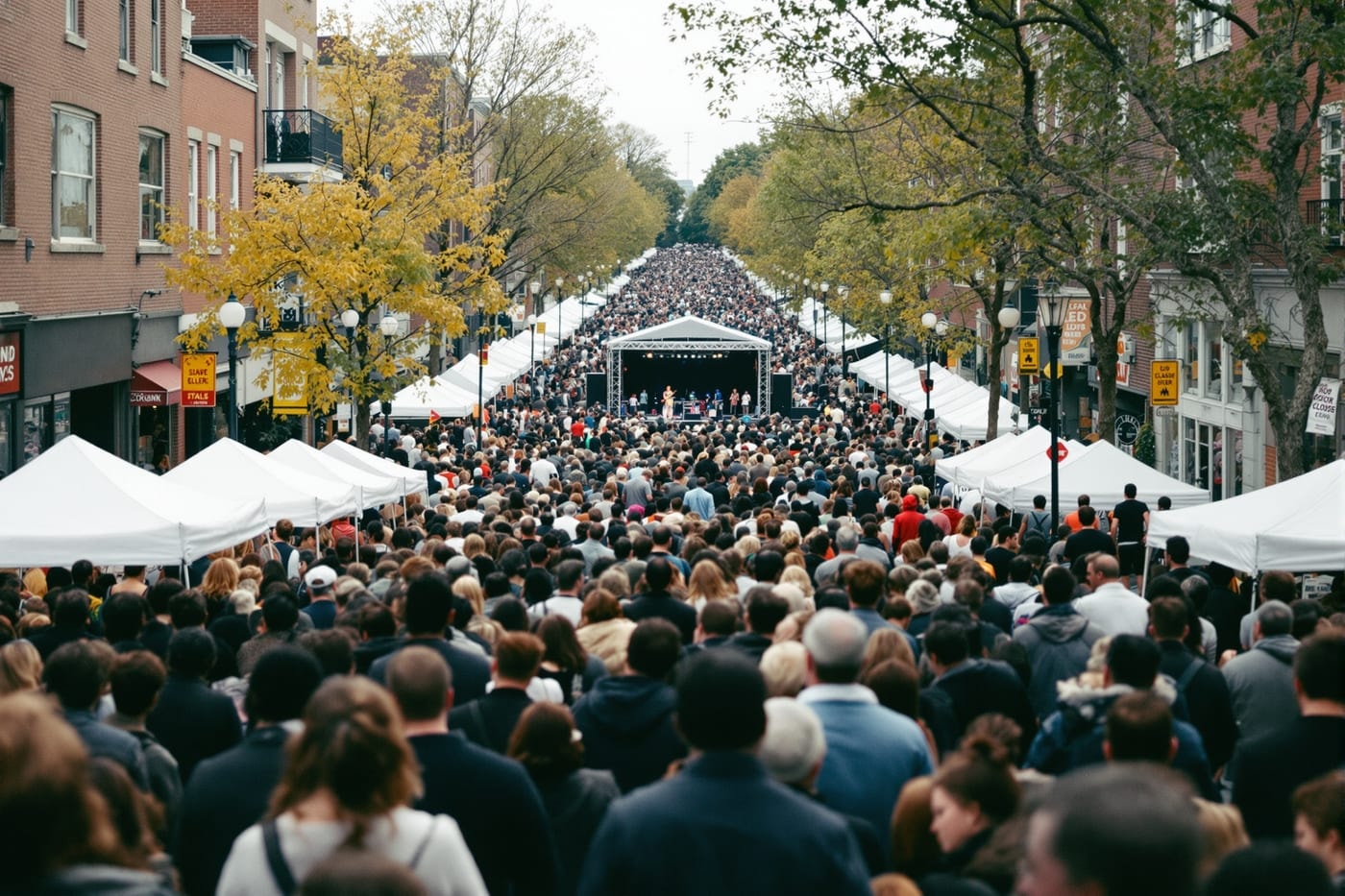
The shape of the day has been broadly stable for decades. The street closes to vehicles across a long run of blocks. Stages go up at intervals, each with its own programming character — go-go and soul at one, rock or hip-hop at another, poetry, dance and spoken word at the performing-arts end. Between the stages the roadway fills with vendors: food, crafts, community organisations, city agencies, campaign tables, church groups. Side streets carry the overflow. It runs through the middle of the day and finishes in the early evening.
The finished scene also hides a second geography: the operational one. A stage is not simply placed at a useful corner; it needs power, a protected working area and enough distance from the next sound system. Vendor rows have to leave an emergency lane open, while food stalls bring permits, washing, temperature control and fire clearance into the plan. Traffic diversions, sanitation, insurance and overnight waste removal all have to be arranged before the public sees a canopy. None of that is peculiar to H Street, and none of it is visible in a photograph of a busy afternoon. Our account of the machinery behind a neighbourhood street festival follows the process from winter planning through the clear-down after the street reopens. It is useful context for the history here because scale changes the work: a gathering counted in thousands and one counted in hundreds of thousands may occupy the same blocks, but they do not ask the same things of permits, site plans, power or volunteers. The spectacle is one day; the operating problem lasts most of a year.
The music matters more than a visitor might expect. Washington has a live-music tradition of its own — go-go, a percussion-driven, call-and-response style that the city later named its official music — and a DC street festival without a go-go band is not really a DC street festival. We cover that on go-go and the sound of a DC street festival.
A note on scale
Early-2000s editions were counted in the thousands. One organiser’s recap of the 2006 event put attendance at over six and a half thousand people and treated that as a strong year. Recent editions have been counted in the low hundreds of thousands. That change is the single clearest measure of what happened to the corridor in the intervening twenty years, and it is worth holding in mind when reading anything written about H Street before about 2010 — including the 2007 edition, which we cover separately because a page about it survives.
How to use this guide
The pages here fall into three groups. History: the festival’s own history, and 1968 and the long rebuilding that shaped everything after it. Culture: the arts district, the music, the murals and public art, and how a street festival actually gets built. Practical: the corridor itself, getting there, eating and drinking, and a general visiting guide.
For dates, times, road closures and anything else that changes from year to year, go to the organisers’ own channels and to the District government — not to us. We do not publish event information, and we would rather send you to a primary source than guess. The DC Office of Planning holds the corridor’s planning record, and the DC Public Library’s local-history collections hold a great deal of the neighbourhood’s documentary history.
Conclusion
H Street NE is a good street to read a city by. Almost everything that has happened to urban America in the last sixty years happened here in a compressed and legible form — a thriving commercial strip, a catastrophe, forty years of very slow repair, an arts district, a streetcar, and an argument about who the recovery was for. The festival is the one thread that runs through the whole of it, which is why a guide to the street keeps coming back to a single Saturday in September.