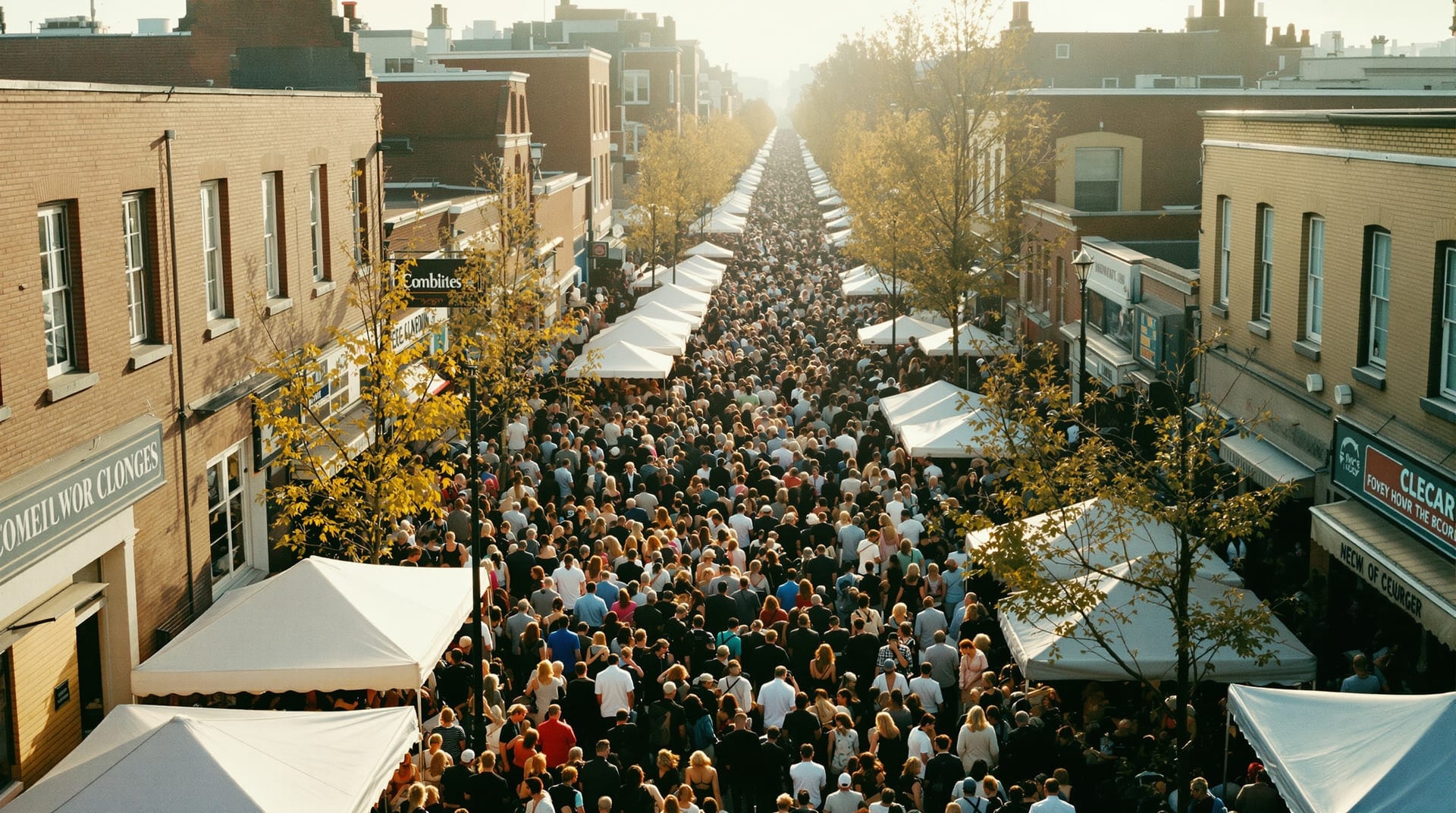
This page covers the practicalities of visiting the corridor — first on an ordinary day, then on the day of the street festival, which is a completely different proposition. For dates, times, closures and programming, always go to the organisers’ own channels and to the District government. We do not publish event information and this page is not an announcement of anything.
On an ordinary day
The corridor is at its most rewarding on a weekday afternoon or a weekend morning, when you can actually see it. Allow two to three hours for the full length with stops.
- Start at the western end, by the railway terminus, and walk east. The street improves as you go and you finish where the food and venues are.
- Morning light favours the north side; late afternoon favours the south. Relevant if you are photographing the architecture or the murals.
- Detour onto the side streets. A block north or south is where the residential fabric and many of the largest painted walls are.
- The eastern blocks change completely after dark. Quiet in daylight, busy and loud at night. Both are worth seeing.
On festival day
The corridor festival is one of the largest street events in Washington and it fills the closed section shoulder to shoulder for most of the afternoon. It is a good day out and it is not a relaxed one.
- Come early. The first couple of hours are pleasant and navigable. The middle of the afternoon is a crush.
- Do not drive. The corridor is closed and the surrounding blocks are unparkable. Arrive by rail or bus to the edge of the closure and walk in — see getting there.
- Expect transit diversions. East–west bus routes are rerouted and the streetcar does not run across a closed street.
- Carry water and some cash. Both make the day easier; mobile signal degrades badly in a crowd that size.
- Agree a meeting point in advance. Phones are unreliable and a fixed physical landmark is worth more than a text message.
- Work the edges. The stage areas are the densest points by a wide margin. Movement along the corridor is much easier a few metres off the centre line, and side streets are the release valve.
- Eat off-peak. See eating and drinking.
Accessibility on festival day
The physical environment is good: flat, step-free, wide reconstructed pavements, consistent kerb ramps. The difficulty is density. Anyone using a wheelchair or pushing a pushchair will find the early part of the day dramatically easier than the middle of the afternoon, and the perimeter blocks easier than the stage areas. Accessible transit information is published by WMATA.
Going with children
Corridor festivals of this kind normally programme a family area with its own stage and activities, usually toward one end of the footprint rather than in the middle. Go early, head straight there, and treat the dense central blocks as a separate expedition or skip them. Ear protection for small children near a stage is a reasonable precaution — outdoor amplified music is loud, and the National Institute on Deafness and Other Communication Disorders publishes clear guidance on noise exposure.
Etiquette, briefly
The corridor is a residential neighbourhood as well as a commercial one, and on festival day several hundred thousand people are in front of people’s homes. The short version: do not block private entrances or driveways, use the bins provided rather than kerbsides and front steps, be careful about photographing people without asking, and remember that residents will still be living there on Sunday morning.
It is also worth spending money on the corridor rather than only at the stalls. The whole logic of a merchants’ festival — see the festival’s history — is to put trade through businesses that are on the street the other 364 days.
Weather and timing
The festival falls in early autumn, which in Washington can mean anything from pleasant to genuinely hot and humid. Plan for sun and heat, take water, and check the forecast — outdoor events of this scale carry weather plans that can pause or curtail programming. Forecasts are published by the National Weather Service.
Conclusion
If you can only make one visit, make it an ordinary one. If you want to see the corridor at maximum volume, come to the festival — but come early, arrive on foot, and be prepared for a crowd. Either way, the walk is the thing: see walking the corridor.