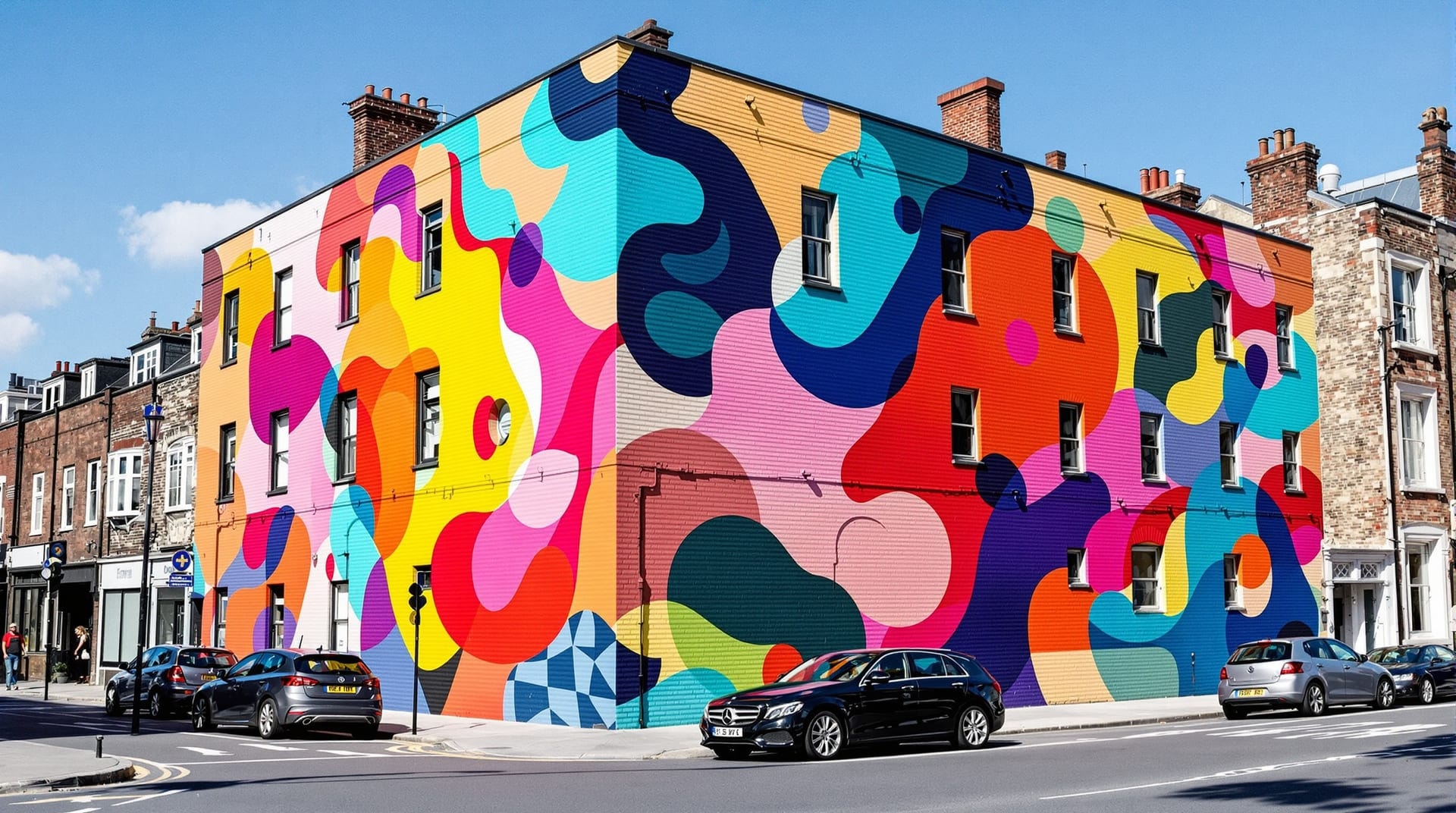
H Street NE has more painted wall per block than almost any comparable corridor in Washington, and the reason is architectural rather than cultural. A street built as a continuous row of party-wall buildings develops large blank side elevations wherever a building is demolished or a lot is left open. Those exposed flanks are the canvases, and H Street acquired a great many of them between 1968 and about 2005.
Why the walls are there
This is worth understanding before looking at any individual work. When a mid-terrace commercial building is lost, the two buildings either side of it are left with windowless brick side walls three storeys high that were never meant to be seen. A corridor that lost a substantial share of its building stock, as this one did, ends up with dozens of them.
For thirty years those walls were simply a visible tally of what had gone. From the 1990s onward they became something else: the largest available public surface in a neighbourhood with a great deal to say. Our page on 1968 and after explains how the gaps appeared.
What is on them
The corridor’s public art divides fairly cleanly into four kinds:
- Commemorative murals — works honouring figures from the neighbourhood’s and the city’s history, and works marking the events of 1968 and the recovery that followed. These are the most explicitly historical pieces on the street.
- Music and culture pieces — a substantial body of work about Washington’s own musical traditions, go-go especially. See go-go and the sound of a DC street festival.
- Commissioned business murals — painted walls commissioned by the businesses that occupy the buildings, ranging from straightforward decoration to serious work by established artists.
- Sculpture and streetscape art — including the public artwork at the corridor’s eastern junction that gives the Starburst intersection its name, plus smaller pieces installed with the streetscape reconstruction.
The Starburst
The corridor’s best-known piece of public art is the sculptural installation at the five-way junction at its eastern end. It is a genuine landmark — people navigate by it, name the surrounding area after it, and use it as the corridor’s eastern full stop. It is also a good demonstration of what public art can do at a difficult piece of road geometry: give an otherwise illegible junction a name and a centre.
Looking at it properly
A few practical notes for anyone walking the corridor to see the artwork specifically:
- Look down the side streets. Many of the largest painted walls face north or south off H rather than onto it, and are invisible if you only walk the main line.
- Go in the morning or late afternoon. Side elevations face east or west, so most walls are only properly lit for part of the day.
- Expect change. Murals on private walls are impermanent by nature — repainted, built over when the adjacent lot is developed, or simply weathered out. A corridor under active development loses walls steadily.
- The eastern blocks are densest. The arts district end carries the highest concentration; see the Atlas District.
Public art and the festival
The two traditions are related. Corridor festivals in Washington have regularly included live painting, artist markets and mural commissioning alongside the music, and the mid-2000s H Street editions were explicitly organised around the visual as well as the performing arts. A festival that puts several hundred thousand people on a street for a day is also the best possible unveiling for a wall that took three weeks to paint.
Context and further reading
The District supports public art through the DC Commission on the Arts and Humanities, which administers grants and public-art programmes across the city. The Smithsonian American Art Museum holds collections and research relevant to American mural traditions, and the National Endowment for the Arts publishes on public art in commercial districts.
Conclusion
The murals on H Street are not decoration applied to a finished street. They are a direct product of how the street was damaged and how it was rebuilt, and they are the most legible record the corridor keeps of what it thinks about itself. Walk the side streets.