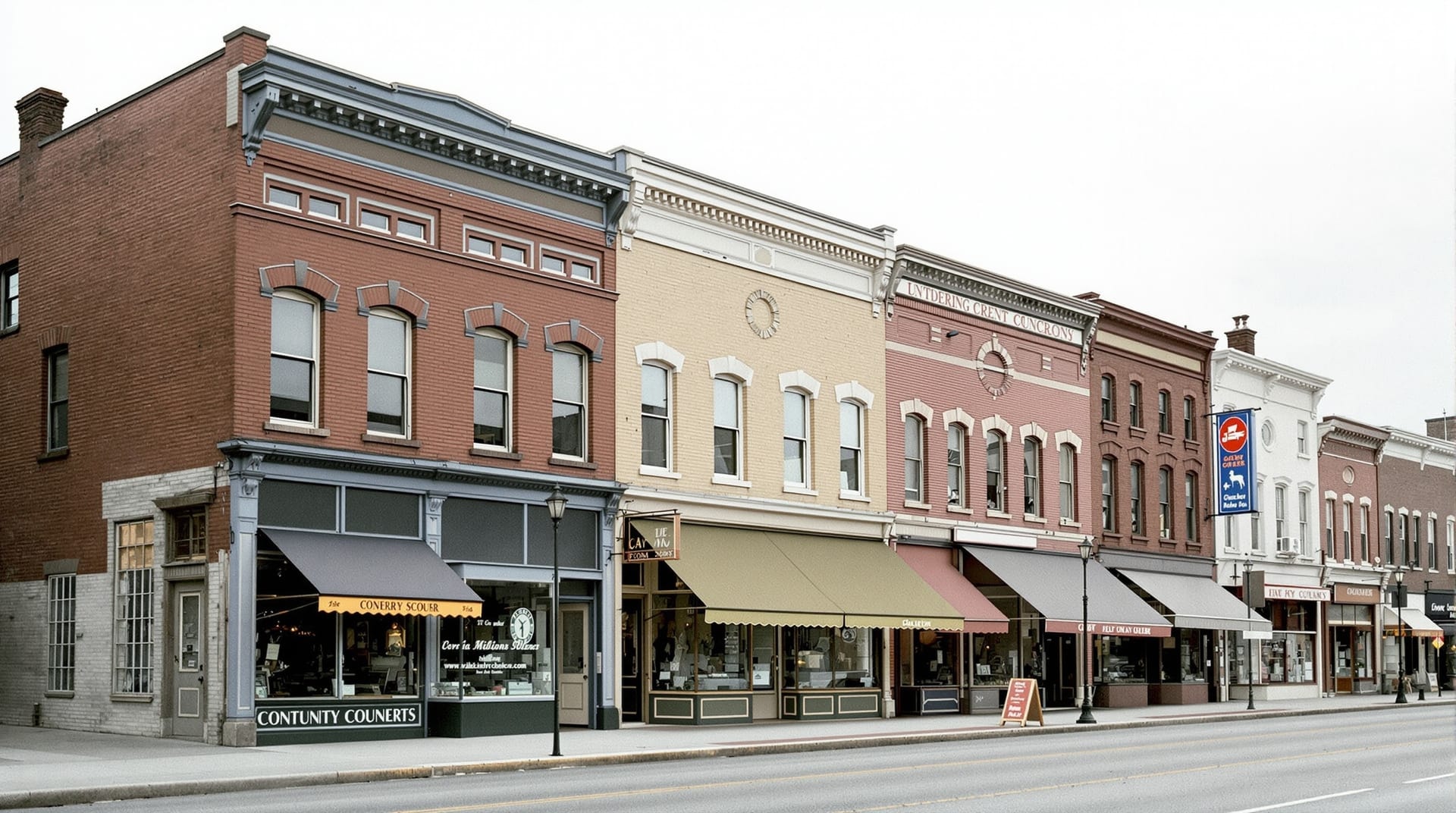
The H Street festival is older than most of the businesses on the street it closes. It has changed name, changed organiser, changed footprint and changed scale by two orders of magnitude, and it has been held on a Saturday in early autumn for the better part of five decades. This is what the record shows about how it got here.
Origins: an argument made in public
The festival began with a coalition of residents and business owners formed in the aftermath of the 1968 civil disturbances. The corridor had been one of the areas worst affected: a substantial share of its commercial buildings were destroyed or damaged, and the insurance, credit and retail withdrawal that followed did more lasting harm than the fires. The coalition’s founders were the people still trading on the street — shopkeepers, church members, long-standing residents — and the festival was one of the tools they reached for.
It is worth being precise about why a street festival is a sensible tool in that situation. A closed street full of people is a visible, physical rebuttal to the idea that a commercial district is finished. It puts customers in front of surviving businesses on a day when they would otherwise be somewhere else. It gives residents a reason to be on a street they might have been avoiding. And it produces a set of photographs that look nothing like the ones in circulation. For a corridor whose central problem was perception as much as economics, that was not a trivial contribution. Our page on 1968 and after covers the wider recovery.
The merchants’ association era
By the 1980s the original coalition had wound down and responsibility for the festival had passed to the corridor’s merchants’ and professionals’ association. This was the festival’s longest and least documented period. It ran as a trade-association event: modest, locally funded, staffed by the same handful of people each year, and largely invisible outside the immediate neighbourhood.
That invisibility is the reason so little survives from this era. There was no website, minimal press coverage, and no archive beyond what individual participants kept. Most of what is known comes from later organisers recounting the lineage, and from the neighbourhood’s own oral history. The DC Public Library’s local-history collections hold material on the corridor’s commercial associations, and the Smithsonian Anacostia Community Museum has documented comparable neighbourhood organising across the city.

2005: the main-street model
In 2005 the festival became a programme of a newly established main-street organisation for the corridor, operating under the District’s Main Streets initiative and answerable to the city’s economic-development office. This was a genuine structural change rather than a rebrand. Main-street programmes come with a defined method — organisation, promotion, design and economic vitality worked as four parallel tracks — and with a small amount of city funding, a paid coordinator, and reporting obligations. You can read about the framework at Main Street America.
Practically, it meant the festival stopped being run entirely by volunteers in their own time and started being run as a programme with a budget line. The 2005 and 2006 editions were organised by volunteer teams working with the new organisation, and by 2006 the event was drawing corporate sponsorship for the first time and being counted in the thousands rather than the hundreds.
2006–2007: the website years
The mid-2000s editions are the best-documented of the festival’s first forty years, because they are the ones with a website. Two independent event planners were engaged to produce the 2006 and 2007 festivals, and they built a promotional site — a video splash page, a sponsorship pitch, a vendor page, a volunteer page and a short institutional history. It is thin by modern standards and it survives only in web archives, but it is the earliest first-person account of the festival’s own lineage that exists.
Those editions also renamed the event: it was billed as a music festival and bazaar, with the arts programming pushed to the front. We look at that year in detail on the 2007 retrospective. Then the site stopped being updated, and the festival carried on without one.
The growth years
What happened next is the part that surprises people who knew the corridor before. Through the 2010s the festival grew from an event counted in the thousands to one counted in the hundreds of thousands, with a footprint stretching across most of the corridor and a dozen or more programmed stages. The growth tracked the corridor’s own transformation — new businesses, a great deal of residential development, a streetcar line, and a wave of city and national coverage that recast H Street from a cautionary tale into a destination.
The scale brought the usual consequences. The festival now requires substantial street-closure and public-safety planning; it has become a significant trading day for corridor businesses rather than a goodwill exercise; and it has attracted the standard set of arguments about whether a neighbourhood event that draws a citywide crowd still belongs to the neighbourhood. Those arguments are real, they are not settled, and they are worth understanding before forming an opinion about the corridor.
What has stayed the same
Across every era, three things have held. The street closes. The music is live, local and heavily weighted toward Washington’s own traditions. And the event is organised by people connected to the corridor’s businesses rather than by a promoter from outside it. Whatever else has changed — and almost everything has — those three constants are why the thing that runs today is recognisably the same festival that a handful of shopkeepers started after 1968.